
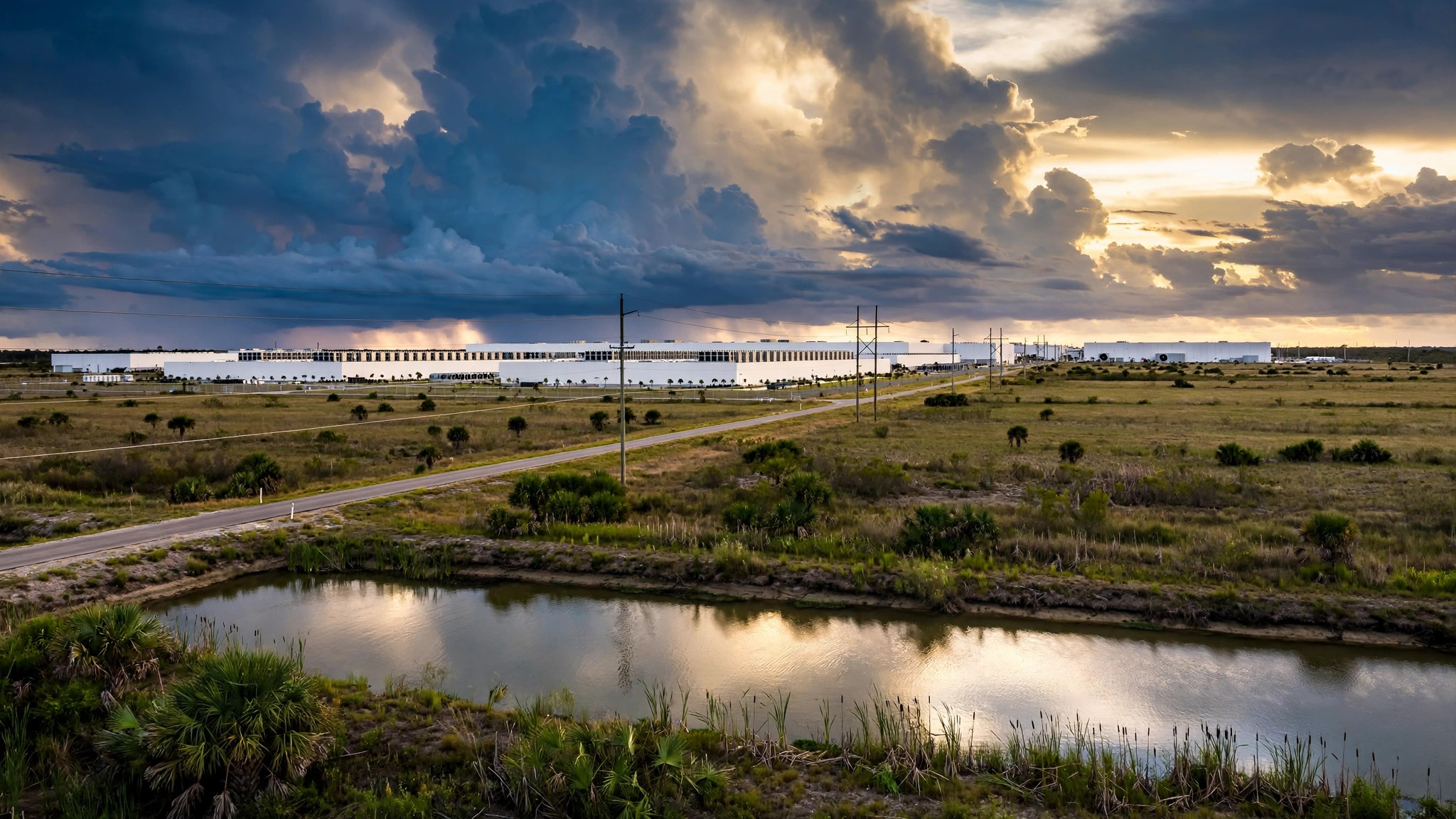
On October 27, 2026, the Martin County Commission voted to stop the data-center industry at the county line for a year. The ordinance, adopted 4–0 at the second of two public hearings, suspends every kind of application for large-scale data centers in unincorporated Martin County — permits, site plans, rezonings, plan amendments — for 365 days.
But the pause has a hole in it, written into the ordinance itself. Part IV states that the moratorium “is not applicable to applications relating to large-scale data centers submitted and deemed sufficient prior to the effective date of this Ordinance.” One application meets that description — the largest ever proposed here.
The story in numbers
A state law written for this moment
The ordinance leans on a 2026 state law — Senate Bill 484, codified as Section 163.326, Florida Statutes — effective July 1, 2026, which expressly preserves local authority to regulate “facilities with substantial electric or other utility demands, such as data centers.” The statute defines the target by appetite: a peak load of 50 megawatts or more.
The county’s reasons are in the ordinance’s own findings: large data centers “require substantial water resources for cooling systems and substantial electrical power to support continuous computing operations, which in some cases require infrastructure demands comparable to small municipalities.” The year is for staff to write permanent rules into the county’s growth plan and land regulations.
The project that beat the clock
The exempt application belongs to Treasure Coast Gateway LLC, an entity of Panorama Holdings, and targets land off Southwest Kanner Highway, near Crystal Lake Elementary School: roughly 959,000 square feet across four buildings on 84 acres.
Two details remain genuinely contested. Timing: the application’s arrival is dated October 12 in TCPalm’s reporting and in Commissioner Sarah Heard’s published board summary, but Deputy Growth Management Director Peter Walden told the commission on the record, “We did get an application in on Oct. 13,” and Commissioner Ed Ciampi echoed the 13th. Scale: TCPalm has reported a power draw of about 130 megawatts; the residents’ petition puts it at roughly 100. At either number, the project would draw power on the scale of a small city.
County Attorney Sarah Elder gave a second reason the project can proceed: projects in platted industrial parks are administratively approved under Article 10 of the county’s Land Development Regulations. The Kanner Highway project may never face a commission vote at all.
The opposition organizes
Opposition has not been quiet. A petition organized by resident Jim Gibbs launched on November 14, and opponents mobilized again at the commission’s November 17 meeting — an organizational session at which the data center appeared on no action item and no vote was taken. In the public debate, the project is routinely called an “AI data center.” That label is the opponents’, not a documented fact: no tenant has been disclosed, and no primary record we reviewed establishes what the facility would actually compute.
Residents’ concerns — cooling water, electricity demand and who pays for the grid capacity, industrial buildings near homes and an elementary school — are the same ones the commission cited when it passed the moratorium. The difference: the moratorium answers them for every future project and, by its own terms, cannot answer them for this one.
What happens next
The moratorium runs 365 days from its filing with the Florida Secretary of State and can be extended only by a new ordinance. The Kanner Highway application continues through administrative review on its own track.
Martin County is the front of a regional wave. Indiantown took up its own moratorium this month — a first vote on November 5, a second reading set for November 19. In St. Lucie County, a developer withdrew a data-center rezoning in February after organized opposition. Martin County’s answer, for now: not yet — except once.
What we don’t know yet
- The tenant. No end user has been disclosed; “AI data center” is an assumption, not a finding.
- The true power draw. Reports range from roughly 100 to 130 megawatts; the applicant has published no number.
- Another hearing. If the administrative-approval reading holds, the public may never get one.
- The exact filing date. Recorded as October 12 in some county accounts, October 13 in others.
Sources & Documents
-
Primary record · Martin County
File 27-0109 — Second public hearing and adoption, October 27, 2026
The official record of the adopting vote.
-
Primary document · Full text
The adopted moratorium ordinance (full text)
The 50-megawatt definition, the 365-day term, and the Part IV exemption.
-
Primary document · County analysis
Business Impact Estimate filed with the ordinance
The county’s estimate of the ordinance’s effect on businesses.
-
Primary record · Martin County
File 26-1141 — First public hearing, October 13, 2026
The first of the two hearings.
-
Local reporting · WQCS
“Data center still under consideration as Martin County moratorium takes effect” — October 29, 2026
Justin Breckenridge on the Kanner application’s status after the vote.
-
Local reporting · WFLX
“Martin County approves 1-year pause on new data center development” — October 27, 2026
Same-day coverage of the vote.
Reporting note: vote counts, the recusal, and the exemption’s legal bases were verified against the county record and contemporaneous reporting. Where sources conflict — the filing date, the power draw — this article says so rather than choosing one.