
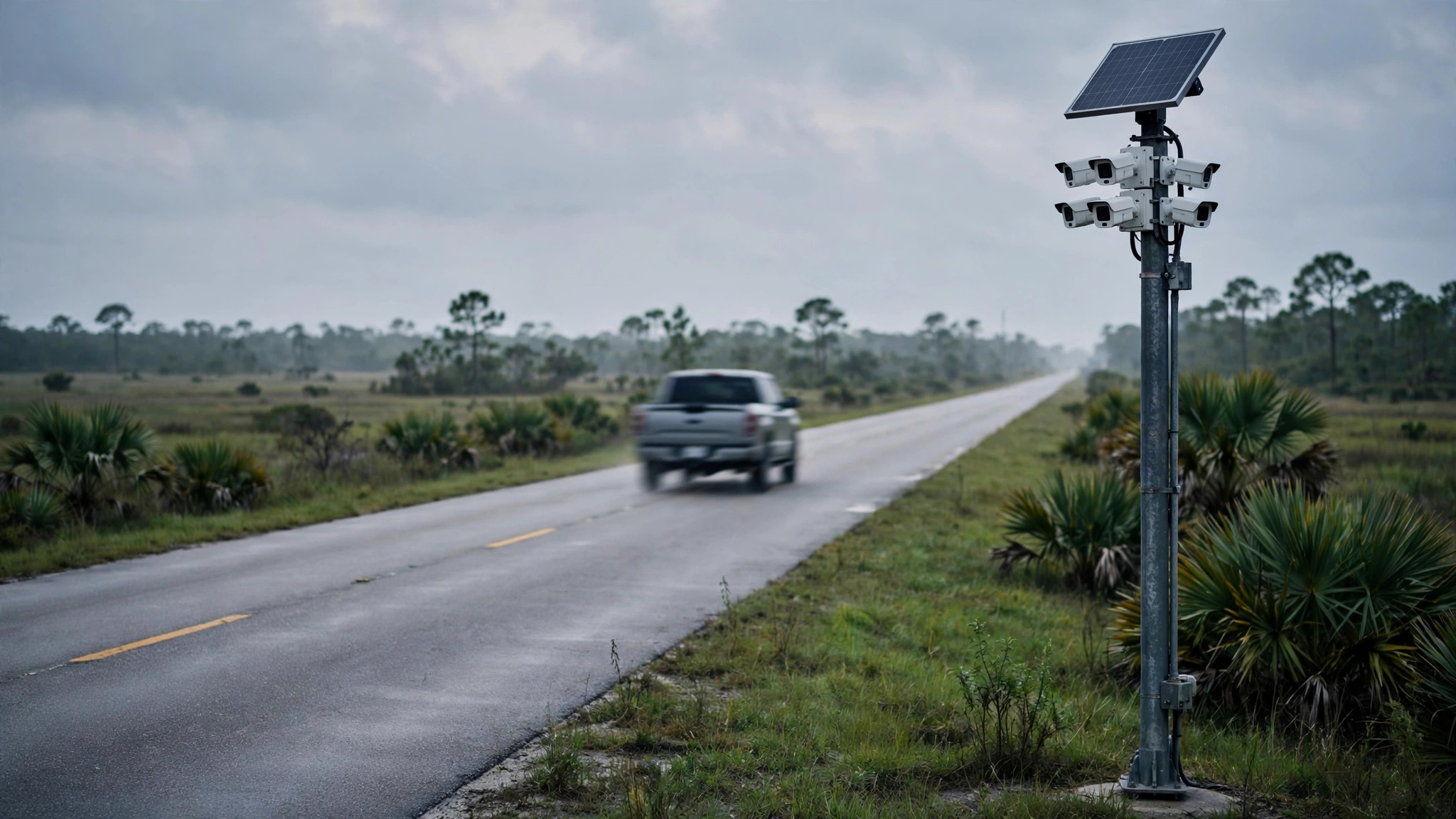
On September 1, 2026, the St. Lucie County Commission voted 3–2 to stop issuing county permits for automated license-plate readers and to direct staff to use lawful steps toward removing cameras from county right-of-way. It was one of the strongest local pushbacks against plate-reader surveillance in Florida, and it followed a state order: on August 31, the Florida Department of Transportation had revoked every permit for plate readers on state roads, after Governor DeSantis said the technology had “gotten out of control.”
Two months later, a quieter document tells the other half of the story. The Sheriff’s Office end-of-year budget amendment — transmitted November 5 and placed on the Board of County Commissioners’ November 10 agenda — lists the Flock Safety plate-reader line in plain figures: annual payments that began at $356,205 effective March 1, 2025, and increased to $391,463 “with the additional licenses.”
The permits came down. The budget line went up. Both facts are in the county’s own records, and until now, no local outlet has put them side by side.
The story in numbers
The budget line, in writing
The Sheriff’s amendment documents the Flock contract as a recurring annual cost — and shows it growing by roughly $35,000 a year as licenses were added.
Budget amendments are not press releases. They are the paperwork an agency files when it needs its numbers to match reality, which is what makes this one useful: it states the plate-reader program’s cost the way the Sheriff’s Office itself accounts for it. The Flock Safety Platform line — license-plate readers, at a $113,000 column figure within the amendment — is described as annual payments of $356,205 beginning March 1, 2025, increased to $391,463 with additional licenses.
Nothing in the document suggests the program is winding down. The trajectory it records is expansion: more licenses, at a higher annual price, in the same season the county was removing cameras from its roads.
Two governments, one county
The Board of County Commissioners controls permits on county roads. The Sheriff is a separately elected constitutional officer with his own statutory budget. The September vote bound the first, not the second.
This is the part of the story that explains the apparent contradiction. The commissioners’ September 1 vote — Clasby, Lowry, and Leet in favor; Fowler and Townsend against — governed county permits and county right-of-way, and it worked: permitted cameras came down in October, and the county’s inventory exposed the unpermitted ones.
But the Sheriff’s Office is not a county department. Its budget is statutory, its contract with Flock Safety is its own, and cameras on city streets or private property were never the commission’s to remove. Port St. Lucie’s police department paused its own program entirely on September 1; the Sheriff’s budget, two months later, shows a program still funded and growing. Whether that is defiance, independence, or simply two offices answering different questions is exactly the debate the county is now having with itself.
What we don’t know yet
- How the board handled the amendment. The November 10 meeting minutes were not yet posted when this article was prepared, so the amendment’s disposition — approved, amended, or questioned — is unconfirmed. We will update this article when the minutes publish.
- What the additional licenses cover. The Sheriff’s Office has not publicly explained them, or how many cameras the current contract supports.
- Whose cameras the seven are. Seven of the unpermitted cameras found on county roads remain unclaimed by any agency, and the county has said it lacks the resources to investigate whose they are. Those cameras were removed; who put them there is still an open question.
Sources & Documents
This article is based on primary public records, read directly. Figures are quoted from the Sheriff’s transmitted amendment; the September vote and the camera inventory are documented in county records and contemporaneous reporting by WQCS and CBS12.
-
Primary record · St. Lucie County
St. Lucie County BOCC records (CivicClerk)
The Sheriff’s FY 2025-26 end-of-year budget amendment, transmitted November 5, 2026, agenda item November 10, 2026.
-
State record
FDOT Memo 26-01 (August 31, 2026) — tracked at SignalData’s Florida ALPR record
Revocation of ALPR permits on state roads under § 316.0777, Florida Statutes.
-
County record & reporting
September 1, 2026 commission vote & October camera inventory — DeFlock Tampa’s dated news file
County staff reports and the removal-round reporting, collected with dates.
Disclosure — Treasure Coast AI monitors Treasure Coast public records, including commission agendas and budget documents, and reports what they show. Allegations are labeled as allegations; charges are not convictions. This article will be updated when the November 10 minutes are published.